

Insights and Statistics from FlairRepublic’s Fractional CMO Report 2025
Most UK leaders say senior marketing leadership is critical for growth, yet a large share are still underpowered and unaware that a flexible alternative even exists.
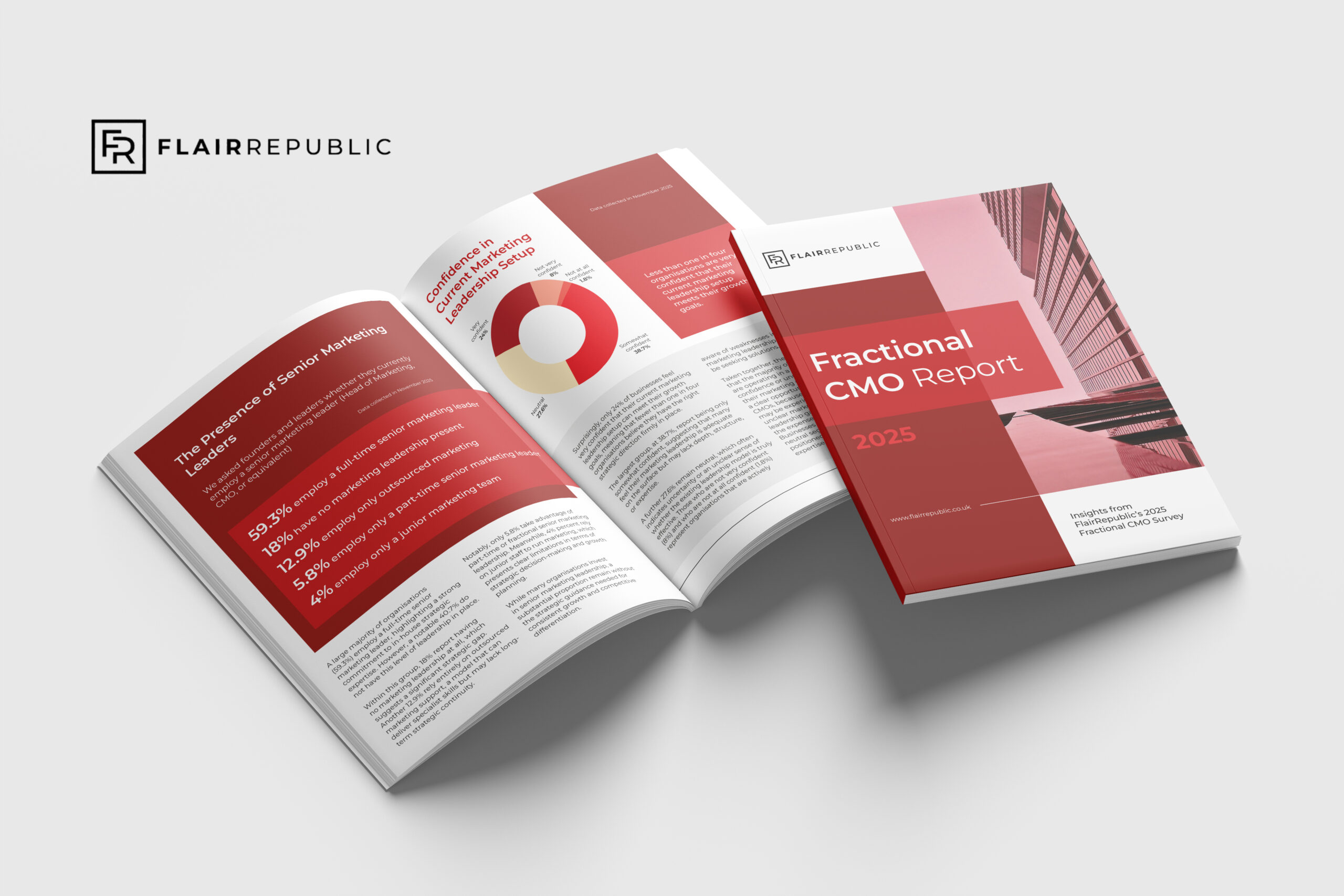
Senior marketing leadership has never mattered more, and yet most organisations are quietly betting their growth on incomplete, under-resourced, or improvised setups. FlairRepublic’s Fractional CMO Report 2025, based on a survey of 450 senior leaders across the UK, shows a clear tension between what leaders say they need and how they actually resource marketing at the top.
Key Takeaways from the Fractional CMO Statistics
On one hand, 73.8% of leaders describe senior strategic marketing leadership as important or critical to their organisation’s success. On the other, fewer than one in four feel very confident that their current marketing leadership model can deliver the growth they are targeting. That confidence gap is where stalled growth, disjointed campaigns, and “random acts of marketing” tend to hide.
Less than one in four organisations are very confident that their current marketing leadership setup meets their growth goals.
The leadership gap inside UK marketing teams
The 2025 fractional CMO data shows that 59.3% of organisations employ a full‑time senior marketing leader, such as a Head of Marketing or CMO, suggesting a strong commitment to in‑house expertise on paper. However, more than 40% do not have this level of leadership in place at all and 18% report having no marketing leadership full stop.
Others are leaning heavily on alternatives that were never designed to provide true strategic ownership. Around 12.9% rely entirely on outsourced marketing support, while 4% leave marketing in the hands of junior teams. Only 5.8% currently use part‑time or fractional senior marketing leadership, despite its ability to plug exactly these gaps.
More than 40% of businesses have no full-time senior marketing leader in place, with 18% of businesses having no marketing leadership at all.
Confidence is low, even where leadership exists
Even where leaders are in place, confidence is fragile. The statistics show that just 24% of respondents are very confident that their current marketing leadership setup can hit their growth goals. The largest segment, at 38.7%, are only somewhat confident, while another 27.6% sit on the fence entirely, signalling uncertainty over whether the model they have is really working.
A further 8% are not very confident and 1.8% are not at all confident, indicating organisations that already know something is broken. Combine these groups and a clear picture emerges: most companies are operating in a state of partial confidence or doubt about their marketing leadership – fertile ground for a better way to access senior expertise.
37.4% feel either neutral, not very confindent, or not at all confident in their current marketing leadership.
Most leaders have never heard of a fractional CMO
At the same time, the fractional CMO model remains largely invisible. The fractional CMO report shows that 68.2% of leaders are unfamiliar with the term “fractional CMO”, with only 6.2% saying they are very familiar and 25.6% somewhat familiar. These statistics mean nearly seven in ten decision‑makers do not recognise the model, even as they describe the exact problems it is built to solve.
This isn’t a story of a crowded market where providers are battling for attention. It is, instead, a story of low awareness and latent demand. Leaders know they need senior strategic marketing leadership; they simply don’t know that a flexible, part‑time version exists that can be scaled to their needs and budget.
68.2% of leaders are unfamiliar with the term “fractional CMO”
What leaders think a fractional CMO actually does
Where awareness does exist, the statistics show perceptions are encouraging but incomplete. When asked what a fractional CMO provides, 61.1% of leaders point to strategic marketing leadership, rightly recognising the role as senior and direction‑setting. However, 44.2% see it as project‑based delivery and 39.1% associate it with day‑to‑day campaign management, blurring the line between strategy and execution.
A further 34% link the role to team mentoring and 28.9% view it as interim senior cover, suggesting that many treat it like a temporary patch rather than an ongoing leadership model. The result is a partial understanding. Leaders sense that fractional CMOs can think strategically, but still underestimate their ability to own the marketing function commercially, sit at board level, and connect brand, demand, and revenue.
The biggest marketing challenges point straight to fractional CMOs
When leaders describe their top marketing challenges, they are effectively writing the fractional CMO job description. Entering new markets (47.3%) and building brand awareness (45.8%) top the list and are classic strategic tasks that demand senior oversight, clear positioning, and robust go‑to‑market plans. Retaining customers (41.3%) and aligning marketing with sales (40.4%) sit close behind, both requiring cross‑functional leadership rather than more isolated campaigns.
Other pain points – generating qualified leads (36.2%), measuring ROI (31.6%), and managing agencies and suppliers (18.2%) – show where tactical activity has outpaced strategic clarity. These are areas where a fractional CMO can connect dots – setting priorities, defining metrics that matter, and making sure agencies and internal teams are all working towards the same commercial outcomes.
Entering new markets and building brand awareness are among the top marketing challenges for businesses
Inside today’s marketing capability gap
The fractional CMO report segments organisations by their current marketing capabilities and, again, shows how exposed many are without senior leadership. Only 37.1% say they have strong strategic leadership internally, meaning just over a third are confident in their ability to set long‑term direction unaided. Meanwhile, 28.4% report being strong tactically but weak strategically, which often looks like a busy team churning out activity without a joined‑up plan.
Another 24.4% admit they lack both strategic and tactical capability, signalling organisations that are under‑resourced, under‑led, or both. Even the 10% who rely primarily on external partners risk misalignment if nobody senior in‑house is responsible for orchestrating partners against clear goals. Taken together, more than 60% of businesses stand to benefit from bringing in a fractional CMO to provide the leadership they currently lack.
Only 37.1% say they have strong leadership internally
How leaders prefer to access senior marketing expertise
When asked about preferred approaches to securing external marketing leadership, 31.3% of leaders say they would choose a full‑time CMO, with 24% opting for a fractional CMO and 9.3% favouring an interim CMO. Only 4.2% see senior agency support as their ideal model, suggesting that most do not view agencies as substitutes for in‑house leadership.
Perhaps most revealing is the 31.1% who are not sure which option they would choose, highlighting a large undecided group. This “movable middle” is a key audience for the fractional model – leaders who know they need senior guidance but are unsure whether to commit to a full‑time hire or keep patching the gap with projects and agencies.
31.3% of leaders say they would prefer a full‑time CMO, with 24% opting for a fractional CMO and 9.3% favouring an interim CMO
What leaders expect from a fractional CMO
Expectations for fractional CMOs focus squarely on board‑level outcomes, not narrow campaign wins. Marketing strategy development, improved ROI and measurement, and faster lead generation and sales growth all score above 40%, with 56.4% specifically looking for accelerated lead generation and revenue. Leaders also expect support with new market expansion (37.6%) and better team performance and leadership (33.6%), signalling a desire to de‑risk scaling and professionalise underpowered teams.
Lower scores for digital transformation and systems (24.2%) and clearer marketing KPIs (18.2%) do not reflect lack of importance but rather a tendency to see these as enablers rather than headline outcomes. In practice, a strong fractional CMO will use data, systems, and measurement as foundations to deliver exactly the growth and ROI that leaders rank highest.
Survey sample data
The survey sample in the 2025 fractional CMO data is weighted toward larger, more complex organisations: 36.3% of respondents come from companies with over 1,000 employees, and the largest revenue segment is businesses turning over £10m or more at 28.8%. Another 24.5% sit between £2m and £10m, meaning the findings reflect a predominantly mature, commercially established audience.
These are precisely the organisations that feel the cost of weak marketing leadership most acutely – where misaligned teams, unfocused spend, and slow decision‑making directly affect growth.
What this means for your business
If your organisation recognises itself in this data, low or partial confidence in marketing leadership, big ambitions around growth, and a sense that your current model is not quite fit for purpose, the fractional CMO model is worth a serious look. It offers access to the same calibre of strategic thinking as a full‑time CMO, but calibrated to the level of investment, structure, and change your business can absorb right now.
For many mid‑sized and larger organisations, the real question is no longer “Do we need senior marketing leadership?” but “What is the smartest way to access it?” The Fractional CMO Report 2025 provides data‑driven benchmarks to help answer that question, showing how peers across sectors, sizes, and revenue bands are resourcing marketing at the top, and where they see the greatest opportunities to improve. We put together the fractional CMO report with our customers in mind, and we’d encourage any business curious about the fractional CMO model to get in touch.
Download the Fractional CMO Report 2025
FlairRepublic’s Fractional CMO Report 2025 brings together responses from 450 senior leaders across the UK to map the current state of marketing leadership: who has it, who does not, how confident they feel, and how aware they are of new models like fractional CMOs. It is designed as a practical tool for CEOs, COOs, CFOs, and marketing leaders to benchmark their organisation, understand emerging options, and decide whether a fractional CMO could unlock their next phase of growth.
To explore the full findings and see how your organisation compares, download the fractional CMO report and use it to stress‑test your current marketing leadership model, your capability gaps, and your options for strengthening them in 2026 and beyond.